Understanding
MOT Advisories
An advisory isn't a failure - but it's a signal. Knowing what to do with it is the difference between a good buy and an expensive one.
What Are MOT Advisories?
During an MOT test, the examiner can record advisory notices alongside the pass or fail outcome. An advisory means a component is:
Not Yet Failed
The item doesn't meet the threshold for a failure at this test - the car passes and is legal to drive.
But Worth Watching
The component is worn or deteriorating. If left unaddressed, it's likely to fail at the next test.
Common examples:"Brake pads wearing thin", "Slight corrosion to exhaust system", "Tyre tread approaching minimum legal limit".
The Problem with Advisories
When you look at a car's MOT history, you'll often see a list of advisories across multiple tests. The challenge is knowing what to do with them:
Which ones matter? An advisory for minor surface corrosion on a ten-year-old car is routine. The same advisory on brake lines is a different matter entirely. The component affected changes the significance completely.
Are they getting worse?An advisory that appears once and then disappears may have been addressed. One that reappears at two, three, or four consecutive tests hasn't been - and the component has been deteriorating through that whole period.
Is this normal for the model?Some models routinely generate specific advisories across thousands of examples - it's characteristic of the design. Without a comparison, there's no way to tell whether an advisory reflects this car specifically or the model in general.
How BIB Analyzes Advisories
BIB doesn't just list the advisories from this car's history - it analyses them against every other example in the dataset:
Tracks Repeat Warnings
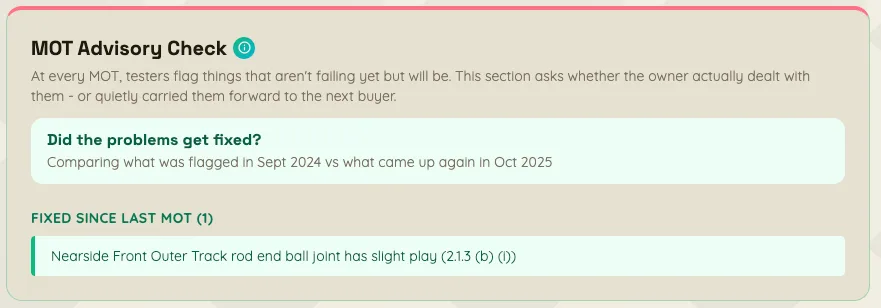
Flags when the same advisory appears across multiple consecutive MOTs, so you can see immediately whether an issue has been addressed or left to run.
Compares to Model Patterns
Shows whether this advisory is common across thousands of examples of this model, or unusual to this specific car - the difference between a design characteristic and a maintenance red flag.
Highlights Escalation
Identifies advisories that have previously converted into failures on subsequent tests for this car or this model, and surfaces them as higher-priority items.
Generates Viewing Checklist
Converts the advisory history into a specific set of things to inspect when you view the car - so you arrive knowing exactly what to look at.
Advisories are data, not diagnosis.
The advisory list from DVSA records is always free. As part of the £3 Bib, BIB turns those items into clear guidance on what's routine, what's a concern, and what to inspect at the viewing.
Part of the MOT Advisory Check - section 5 of 13
Get a Bib - £3Quick Answers
What is an MOT advisory?
An MOT advisory is a notice recorded during an MOT test for a component that has not yet failed but is worn or deteriorating. The car passes and is legal to drive, but the item is expected to need attention before the next test. Common examples include thinning brake pads, tyre tread approaching the legal minimum, or early corrosion on an exhaust system.
How serious is an MOT advisory?
It depends on the component and pattern. Some advisories are routine - brake and tyre wear appears on the majority of cars of a certain age and mileage. Others indicate something more serious: a mechanical advisory that reappears at multiple consecutive tests shows the owner hasn't repaired it. BIB's MOT Advisory Check tracks which advisories were resolved between tests and which were carried forward.
Should I be worried about an MOT advisory when buying a used car?
Not necessarily. The key questions are: Is this advisory typical for the model at this age and mileage? Did it appear once and disappear (resolved) or recur across multiple tests (ignored)? Is it a consumable wear item like brakes or tyres, or a mechanical component that should have been repaired? BIB answers all of these by comparing this car's advisory history against 144 million records from similar vehicles.
What is the difference between an MOT advisory and an MOT failure?
An MOT failure means the car does not meet the legal minimum standard and cannot be driven on a public road until the item is repaired and a re-test passed. An MOT advisory means the component is deteriorating but has not yet reached the failure threshold - the car passes and is road-legal. Both matter when buying a used car: failures show what has gone wrong, and advisories show what is heading in that direction.
What it looks like in your report
MOT Advisory Check screen