Not opinion. Not forums. The actual MOT record for this model - ranked against the cars a buyer would realistically choose between.
What the Reliability Rating tells you
Some cars have a known reputation for failing MOTs. Others quietly pass year after year. The Reliability Rating shows you where this model sits - not based on reviews or forums, but on what actually happens when cars of this type go in for their annual test.
It answers a simple question: compared to cars a buyer would realistically choose between, how does this one hold up?
How BIB calculates it
The rating is a percentile - a position, not a raw score. We take every model of the same type (same body style, fuel type, and era) that has enough MOT records to be statistically reliable, rank them all by their failure rate, and show where this model sits in that ranking.
A score of 73 means this model has a better MOT pass record than 73 out of every 100 comparable cars. It's not 73 out of 100 in some abstract sense - it's 73rd percentile within its actual peer group.
The peer group is shown on every report, so you know exactly what's being compared: "Ranked against 233 family hatches 2006-2012."
The numbers behind it
Every test on every UK car from 1990 to today - passes, failures, and advisories.
Every make, model, and production year with enough data to be statistically meaningful.
Minimum before a model is included in peer group comparisons. Small samples produce unreliable rankings.
Profiles with fewer than 500 tests are excluded from peer groups. Low-volume or recently introduced models may not receive a rating for this reason.
See the full dataset - 144M records, 13 intelligence types, and the methodology behind every score.
Brand ranking
Every report also shows where the manufacturer ranks nationally. This is calculated separately - across all of that make's models from the last 15 years, weighted by test volume. A brand with a strong fleet-wide record should have a higher bar to clear, and the rating accounts for that.
What it looks like in your report
App screengrab
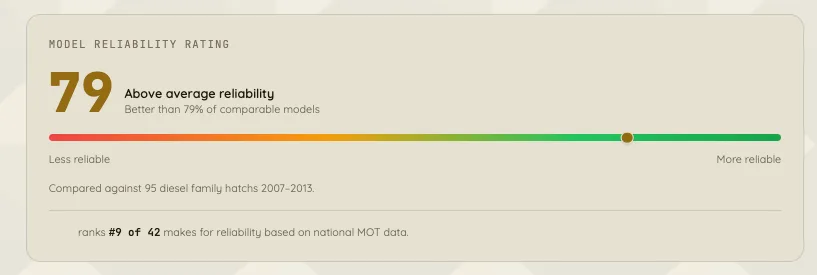
Every car has a reliability story. This is the model's - ranked against the cars a buyer would actually consider instead.
How to use it
A high score
This model has a strong record among cars of its type. You're not walking into a known weak spot. Pair it with the full MOT history to see how this specific car has performed.
A low score
A lower-scoring model isn't automatically a bad buy - but go in knowing what you're taking on. A well-maintained example at the right price can still make sense. Use the score to ask sharper questions at the viewing, not to make automatic decisions.
When no rating appears
Low volume makers
Not every car gets a Reliability Rating. For some models, BIB shows nothing rather than show a number that isn't trustworthy. Here's why.
Too few cars on the road
The rating only means something if it's based on enough real data. A model with a handful of MOT records might show a 0% failure rate simply because there aren't enough tests to have had a failure yet - that's not reliability, that's luck. BIB requires a minimum number of national MOT records before a model is eligible for a rating, and a separate, higher minimum before it can be used as a comparison point for others.
If a model doesn't clear those thresholds, no rating is shown. A blank is more honest than a misleading number.
Specialist and low-volume vehicles
For cars from specialist makers - think Ferrari, Aston Martin, Bentley, McLaren - the MOT picture is different by nature. These cars are built in small numbers, often serviced outside the normal garage network, and the people who own them tend to maintain them differently to the average buyer. Comparing a Ferrari to a family hatchback of the same age would produce a number, but not a useful one.
For these cars, BIB shows what the MOT history of this specific car tells you - which is often the more relevant question anyway. How has this particular car been looked after? That matters more than a peer comparison that doesn't have meaningful peers.
What this means for you
If a rating appears, it's based on real volume and a genuine comparison group. If it doesn't appear, BIB is being straight with you rather than filling the space with something that looks authoritative but isn't. The car's own MOT history - every test, every failure, every advisory - is always shown regardless.
See the Reliability Score for any car
One of 13 intelligence sections in every BIB report. £3 per car.
Open BIB